The AAA Lesson Plan is a quick-method lesson plan to assist your teaching or training needs in a simplistic fashion that can deliver in depth knowledge and understanding of any subject. The lesson plan is made up of activities rather than lectures. The objective of the instructor is to keep an active learning environment through activities.
The lesson plan is broken into three stages:
- Activate stage (pre-assessment)
- Acquire stage (during-assessment)
- Assess stage (post-assessment)
1. Activate
The first stage is called activate. The term is actually what it means. You need activation. Our brain is like a Singer sewing machine.
The brain has an on/off button. We must find that on button and… well, turn it on. This concept comes from the first of six cognitive domains from Bloom’s Taxonomy, which is accessing prior knowledge so the learner will be able to recognize the material and the instructor will know what level to work with; a win-win situation!
All of the approaches are done through activities. These are the pre-assessment activities used in the activation stage. There can be more types so this list is certainly not exhausted:
- quiz/test
- talk about quote
- survey
- concept formation
- agree/disagree
- journal
- K-W-L
- discussion questions
- photo or picture
Later posts, I will go into detail explaining how each of these activities can be used.
2. Acquire
The second stage is called acquire. This is a fancy word for gathering or obtaining information presented. I like the analogy of picking flowers. Each stem picked is the knowledge collected and stored in your brain.

This is the “meat and potatoes” of the lesson plan. This is where the section addresses the instructor’s main goal:
“What should students know and be able to do?“
This is the list of activities for the acquire section:
- lecturette
- demonstration
- jigsaw
- video
- field trip
- guest speaker
- text / reading
- audio/podcast
Later posts, I will go into detail explaining how each of these activities can be used.
3. Assess
Finally, the last stage is called assess. This simply means test. We want to test the students to make sure the information or flowers picked are obtained. Now, I use pre, during, and post assessment along each section. Although the last stage is focused on testing, you will be evaluating and assessing through all stages to make sure the students are understanding the material so the output will stay productive.

There are many ways to test the students and this list of activities is certainly not exhausted:
- quiz/test
- performance
- log/journal
- portfolio
- metacognition (case study, personal experience)
- checklist
- products
Later posts, I will go into detail explaining how each of these activities can be used.
The AAA Lesson Plan in a Nutshell
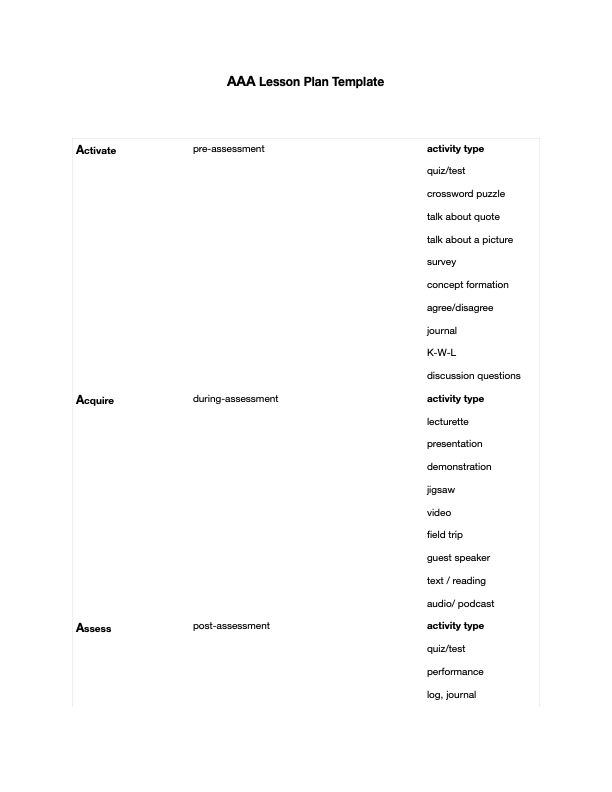
Below is the AAA Lesson Plan Template. There are three columns: activities, assessment, and activity type. I keep this template taped up like poster so when I decide to create a lesson plan I can pick and choose the activity types from each section. Please note that the activity types may increase or change as see fit.
My next post will explain how to use the template.
Conclusion
I believe the simplistic designs are the most effective ways. Throughout this blog, I will demonstrate how to use this template and develop a lesson plan using the three sections. I have over 50 lesson plans developed from this template and they have been applied in the classroom.
So, I welcome you to join me as I share my ideas and experiences. I also invite you to leave comments and your ideas that can expand on these lesson plans!
 AAA Lesson Plan Template